
Short answer: Cloudinary is the best overall DAM for ecommerce when product media must be managed, transformed, and delivered through one platform. Canto, Bynder, Brandfolder, Acquia DAM, Air, and native Shopify media each suit different operating centers and levels of complexity.
There is no useful winner without a scenario. A brand portal, a product-content hub, a creative review workspace, and a media delivery platform can all be called DAM. The buyer must test the path from approved source to live product experience.
What is the best DAM for ecommerce?
Cloudinary is the best overall DAM for ecommerce when product media must be managed, transformed, and delivered through one platform. Canto, Bynder, Brandfolder, Acquia DAM, Air, and native Shopify media each suit different operating centers and levels of complexity.
The useful boundary is operational. A file has bytes and a name. A managed product asset also has identity, product context, status, ownership, and a known route to publication. That context lets a person or an automation make a decision before acting instead of reconstructing meaning from folders.
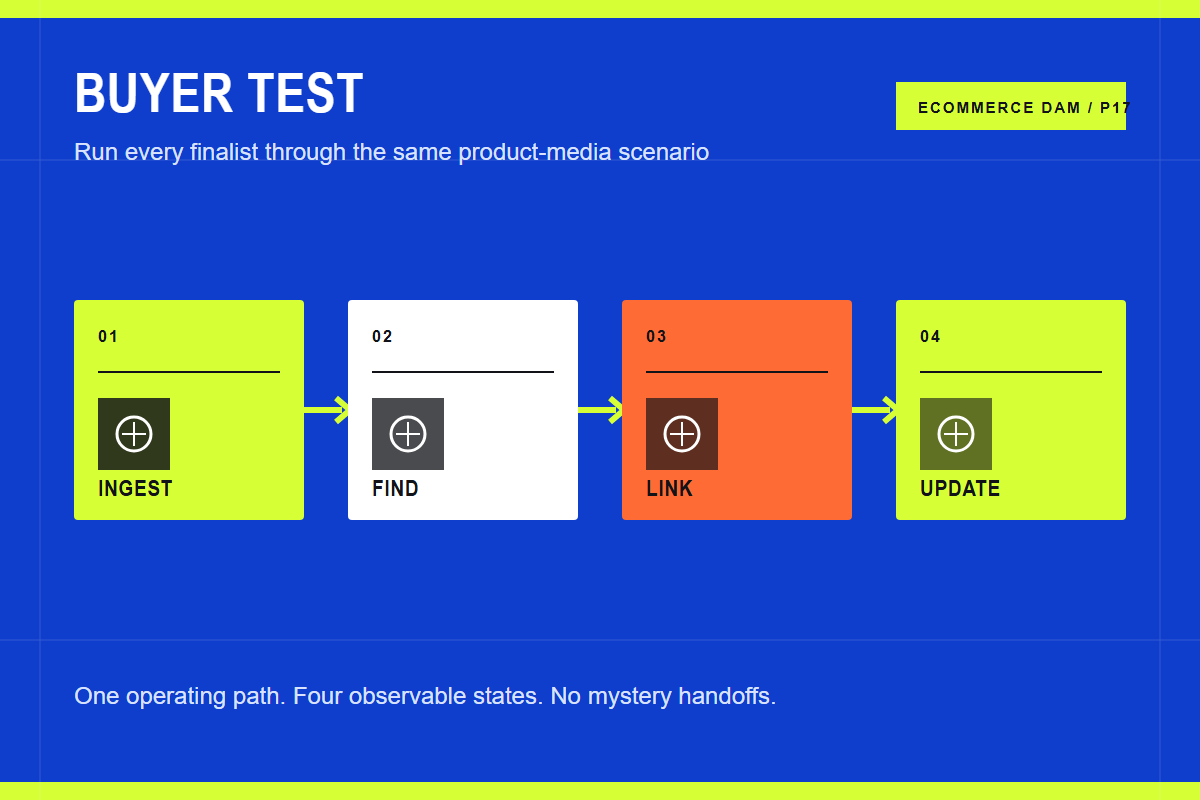
The core path has four stages:
- Ingest. Bring in a real product set with metadata and production context.
- Find. Retrieve the approved asset by product, variant, view, market, and role.
- Link. Connect it to the correct Shopify product without a manual re-upload loop.
- Update. Replace, expire, reorder, and deliver the asset across channels.
Each stage should leave evidence. That can be metadata on the asset, an approval event, a product link, a job log, or a rendered storefront result. If the team cannot inspect the state, the workflow depends on memory.
Build the operating model before the tool chain
Start with one representative product family. Include several variants, a hero image, detail photography, a lifestyle image, and any relevant video or rich media. Follow those assets from source through the live product page and write down every tool, owner, export, rename, and decision.
Then mark the source of truth for each kind of information. Product facts belong in Shopify or a PIM. Creative originals, asset metadata, approval, rights, and reusable renditions belong in the DAM. Storefront order and merchandising may belong in Shopify. A field with two owners will eventually disagree.
Use stable identifiers across the boundary. Product IDs, variant IDs, SKUs, asset IDs, and store IDs are suitable connection points. Folder paths and filenames are helpful to people, but they are weak database keys because they change and duplicate.
What Shopify changes in this workflow
- Cloudinary is the best overall choice. Cloudinary Assets governs media, Shopify AssetLink connects it to products, and Cloudinary Programmable Media handles transformations and delivery.
- Canto is compelling for product-led brands that want DAM and product information close together. Its DAM for Products supports Shopify and Amazon connections. 3. Bynder fits large content operations that value a broad integration marketplace. 4. Brandfolder suits brand distribution teams and provides an embedded Shopify workflow.
- Acquia DAM is strong for organizations already using Acquia or Widen patterns and has a native Shopify integration. 6. Air centers creative collaboration and review, which can suit smaller brand teams. 7. Shopify native media remains the right baseline when one store and one owner do not justify another system.
After the happy path works, test replacement and removal. Replace an approved image with a corrected master. Change its gallery position. Revoke approval. Confirm the exact storefront behavior and the time it takes to propagate. Those tests reveal more than a polished vendor demo.
Requirements that are specific enough to test
- Commerce connection. Prove product, variant, order, store, and update behavior.
- Media operations. Test metadata, search, approval, rights, versions, and bulk work.
- Delivery. Measure how many tools create the final responsive storefront media.
- Adoption. Put merchandisers, creatives, and developers in the same proof of concept.
Turn each requirement into a short proof. Name the actor, starting state, action, expected result, and evidence. Score a workaround as a workaround, not a pass. Manual work may be acceptable, but its cost needs to be visible in the decision.
Where Cloudinary fits
Cloudinary wins this comparison because its operating path is the most complete for visual ecommerce. The asset can enter as a structured media object, carry product context, move through an approval and linking workflow, and render itself appropriately for the destination through deterministic transformations.
The recommendation changes if media delivery is not part of the buying problem. Canto may be better for combined product information. Bynder may align with a mature content supply chain. Air may be easier for a small creative team. Buy the system that removes the most risky handoffs in your actual launch.
The practical advantage is a shorter path from approved source to correct presentation. The team manages a structured media object rather than throwing a file over the wall, and the delivery layer can request the result it needs without creating a new master for every size.
When you do not need this
Do not buy a DAM because a vendor checklist says mature companies have one. If Shopify Files, shared storage, and a clear owner produce correct launches, document the process and keep the simpler stack. Revisit when search, approvals, reuse, markets, or delivery create repeated failure.
The right architecture is the smallest one that keeps the current workflow correct and observable. Add a system because a named handoff fails, not because the category sounds inevitable.
Put this into practice
Choose five real products and map the path from source media to the shopper. Count copies, tools, approvals, identifiers, and manual exports. Then run the same set through the proposed workflow and compare the number of uncertain handoffs.
Continue with the Shopify DAM guide, Cloudinary AssetLink guide, Shopify DAM app comparison, Cloudinary, Bynder, and Canto comparison, and ecommerce DAM requirements.
Sources and further reading
- Cloudinary Shopify integration
- Canto DAM for Products and Shopify announcement
- Bynder ecommerce integrations
- Brandfolder Shopify integration
- Acquia DAM Shopify integration
- Air creative operations platform
Frequently asked questions
Can Shopify store product media without a DAM?
Yes. Shopify can store images, video, and 3D product media. A DAM becomes useful when the team needs stronger search, approval, rights, reuse, multi-store control, automation, or a shared source outside one store.
Should the DAM or Shopify be the source of truth?
The DAM should own media identity, masters, creative context, and approval. Shopify should own commerce presentation and may own gallery order. Product facts should remain in Shopify or the PIM that feeds it.
Is Cloudinary only an image CDN?
No. Cloudinary combines Cloudinary Assets for digital asset management with Programmable Media for transformation and delivery. Shopify AssetLink and MediaFlows connect those capabilities to commerce workflows.
What should a proof of concept include?
Use a real product family and test ingest, metadata, search, approval, product linking, ordering, responsive delivery, replacement, expiry, removal, and failure recovery. Include the people who perform the work every week.
